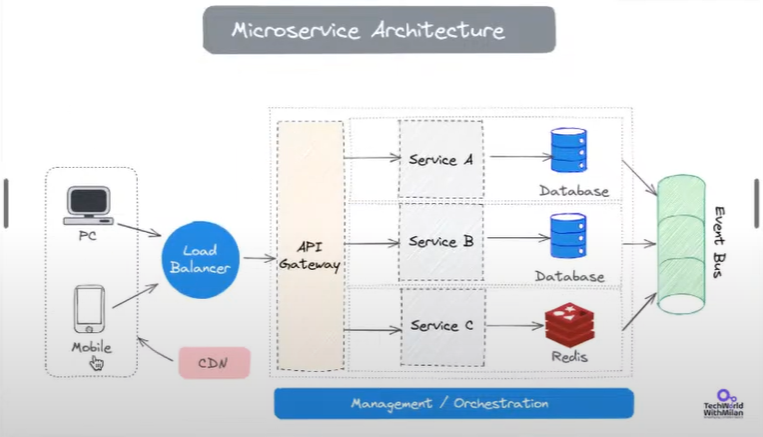
Example
| Independent from each other: |
You should be able to completly shutdown a microservice and this should not bring down any other microservice. | |
Will communicate with each other by an Event Bus (API's, Queues, Streams, etc.) | Meaning that they also won't directly access other services databases. | Will have eventual consistency, because of this async communication. |
Example
 #### Death Star
{% hint style="info" %}
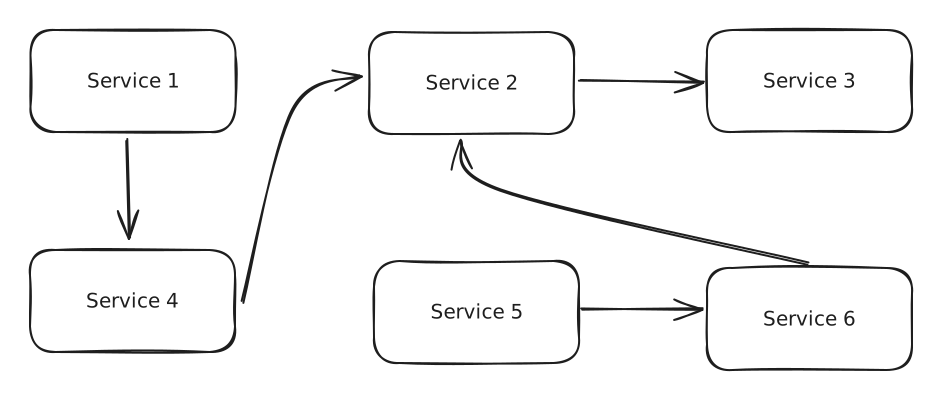
In some extreme cases, where you have thousands of microservices you may end up with a topology like [Death Start](https://www.linkedin.com/pulse/netflix-great-devops-netfix-do-microservices-therefore-sankar-balu/).
{% endhint %}
#### Mitigate Death Star - with `Mini API Gateway`
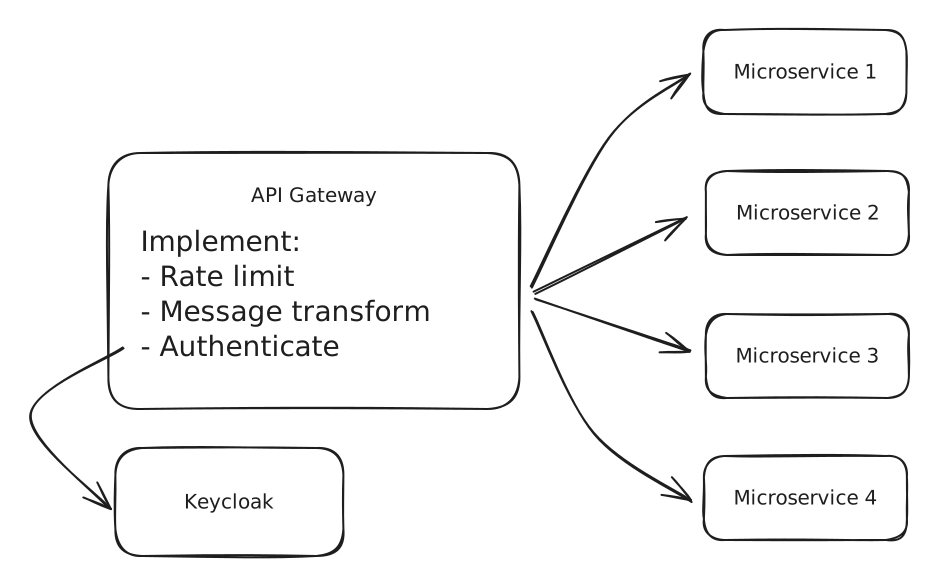
You add `API Gateways` in front of a group of Services. *(That usually are in the same Context)*
It is also possible to add rules, like `Limits`, `Transformations`, and other resources available by an `API Gateway`.
#### Death Star
{% hint style="info" %}
In some extreme cases, where you have thousands of microservices you may end up with a topology like [Death Start](https://www.linkedin.com/pulse/netflix-great-devops-netfix-do-microservices-therefore-sankar-balu/).
{% endhint %}
#### Mitigate Death Star - with `Mini API Gateway`
You add `API Gateways` in front of a group of Services. *(That usually are in the same Context)*
It is also possible to add rules, like `Limits`, `Transformations`, and other resources available by an `API Gateway`.
 ### Orchestration
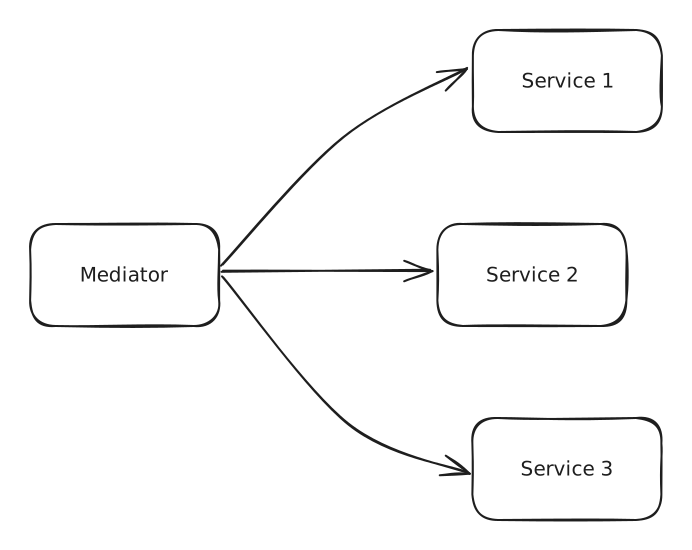
It is a centralized way of setting up communication between services, where a `Mediator/Orquestrator` is used to handle which service should be called after another.
And if something goes bad between a transaction, the `Mediator` can undo all in the correct order.
{% hint style="warning" %}
`Mediator` can become Single Points of Failure in the architecture.
To deal with this, the `Mediator` can be **stateless** (saving each step in a DB), or with [Patterns](/kdocs/microservices/patterns.md#transactional-outbox).
{% endhint %}
### Orchestration
It is a centralized way of setting up communication between services, where a `Mediator/Orquestrator` is used to handle which service should be called after another.
And if something goes bad between a transaction, the `Mediator` can undo all in the correct order.
{% hint style="warning" %}
`Mediator` can become Single Points of Failure in the architecture.
To deal with this, the `Mediator` can be **stateless** (saving each step in a DB), or with [Patterns](/kdocs/microservices/patterns.md#transactional-outbox).
{% endhint %}
 ## Resilience
At some point every system will fail, so how can I mitigate these risks of data and transactions loss.
A system in a distributed architecture should adopt auto-preservation mechanisms to garantee its operation.
Also a system should not be selfish in doing non-stop requests to another failing system.
### Indepotence & Fallback policies
Indepotence is the ability to detect and deal with duplicity. *(Ex.: Duplicated requests sent to Queues)*
{% hint style="danger" %}
Communication between services **MUST** be idempotent.
{% endhint %}
Fallback policies to define what should happen or what should be done when something is unavailable.
### Observability
Help alot with APM (Application Performance Monitoring).
Allows easy tracing of errors with **Distributed Tracing**.
Personalized metrics.
### Healthcheck
A mechanim to check the health of systems.
An unhealth system have a chance to recover, if traffic can be redirected out of it.
{% hint style="info" %}
A good healthcheck also tests the system's dependencies.
{% endhint %}
#### Active healthcheck
In active mode, the system itself will self ping and check its health.
#### Passive healthcheck
In passive mode, the system will only know its health after someone else checked for him.
### Rate Limiting
Can protect a sytem based on the limits it was supposed/build to handle.
### Circuit Breaker
It protects a system, making all requests to it to be blocked.
## Resilience
At some point every system will fail, so how can I mitigate these risks of data and transactions loss.
A system in a distributed architecture should adopt auto-preservation mechanisms to garantee its operation.
Also a system should not be selfish in doing non-stop requests to another failing system.
### Indepotence & Fallback policies
Indepotence is the ability to detect and deal with duplicity. *(Ex.: Duplicated requests sent to Queues)*
{% hint style="danger" %}
Communication between services **MUST** be idempotent.
{% endhint %}
Fallback policies to define what should happen or what should be done when something is unavailable.
### Observability
Help alot with APM (Application Performance Monitoring).
Allows easy tracing of errors with **Distributed Tracing**.
Personalized metrics.
### Healthcheck
A mechanim to check the health of systems.
An unhealth system have a chance to recover, if traffic can be redirected out of it.
{% hint style="info" %}
A good healthcheck also tests the system's dependencies.
{% endhint %}
#### Active healthcheck
In active mode, the system itself will self ping and check its health.
#### Passive healthcheck
In passive mode, the system will only know its health after someone else checked for him.
### Rate Limiting
Can protect a sytem based on the limits it was supposed/build to handle.
### Circuit Breaker
It protects a system, making all requests to it to be blocked.
| Closed Circuit | Requests arrive normally. | |
| Opened Circuit | Requests are blocked. | |
| Semi Opened Circuit | Allows limited amount of requests, for system check reasons. |
 {% hint style="info" %}
*Ex. of API Gateways:*
`Kong`
{% endhint %}
### Service Mesh
It can control and monitor the entire network, by using `Proxies` in front of the services.
The Service Mesh handles, `Rate limiting`, `Healthchecks`, `Circuit Breakers`, `Retries`, etc..
{% hint style="info" %}
*Ex. of API Gateways:*
`Kong`
{% endhint %}
### Service Mesh
It can control and monitor the entire network, by using `Proxies` in front of the services.
The Service Mesh handles, `Rate limiting`, `Healthchecks`, `Circuit Breakers`, `Retries`, etc..