# Agile Manifesto
## About
* Individuals and Interactions over processes and tools.
* Working software over comprehensive documentation.
* Customer collaboration over contract negotiation.
* Responding to change over following a plan.
## Agile Mindset
Not explicitly presented in the agile manifesto.
* See setbacks as LEARNING OPPORTUNITIES.
* Adopt
* SHORT DELIVERY CYCLES to be able to do rapidly,
* COLLABORATION between business and technical,
* AND CHANGE, handle changes not seeing them negatively.
* Focus on DELIVERING VALUE, what the customer needs.
We focus on these thing, and everything else is waste.
## Agile Values
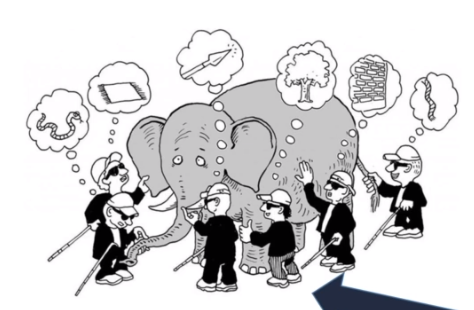
**Individuals and Interactions**** over ****processes and tools**
All of them are touching some part of the elephant and thinking something, but they are all wrong.\
But if they share their knowledge, they will most probably guess the correct think.
This is a analogy of a complex problem.
* A massive problem to be identified.
* People with different set of skills, experience, view points.
And only working together they can work efficiently.
**Working software**** over ****comprehensive documentation**
Remember IKIWISI, if the problem is complex, the customer needs to see something tangible so they can have an authentic experience using it, and give back their feedback.
So focusing more on delivering the product, and less on documentation also increases our responsiveness to change.
**Customer collaboration**** over ****contract negotiation**
We don't know precisely what the customer wants. Thus we need them in our side, to help build the right product.
The idea here is having the customer as part of the team.\
But must require good faith and commitment from both parties.
**Responding to change**** over ****following a plan**
Close related to values 2 and 3.\
We present a working product to the customer, they see it, touch it, uses it, and gives us feedback. (Collaborate with us)
This feedback might lead to changes in the original plan, and then we respond and change.
**Conclusion**
The important thing, is that you must VALUE more the thing in the left side.\ But you also do the things on the right side.
***Being agile is not an excuse for not doing the things in the\*\*\*\* ****right side****.***