# Basics Concepts (Not Scrum related)
## **What is a Project?**
Every project is fundamentally unique, since there are variables that change from one to the other, event if the two projects are to achieve the same product.
It is a temporary effort that produces something unique. (*Be it a product, service or other outcome*)
For instance: `Designing a new car is a project`.
**Project Management**
Is the process of leading the work of a team to achieve goals and meet success criteria within specified restrictions suck as time and budget.
**What is an Operation?**
* Are permanent in nature, which means that they flow continuously.
* Instead of being considered a unique effort, it often repeats the same process over and over.
For instance: `Manufacturing a car, is an operation`.
**Project and Operation**
They have similarities like:
* Having a purpose
* Using constrained resources:
* Time
* Money
* People
* Require management activities.
* Planning
* Execution
* Control
## Traditional
{% hint style="info" %}
Also known as plan-driven or proactive.
{% endhint %}
* Focuses on planning everything that will be made from the beginning until the end of the project.
* You need to predict and plan, in detail, everything that will be done from the project start to end.
* Produces lots of documentation.
* Changes end up being resisted and bureaucratized.
* The product, service or outcome is made available ONLY during project closure (*Late Stages*).
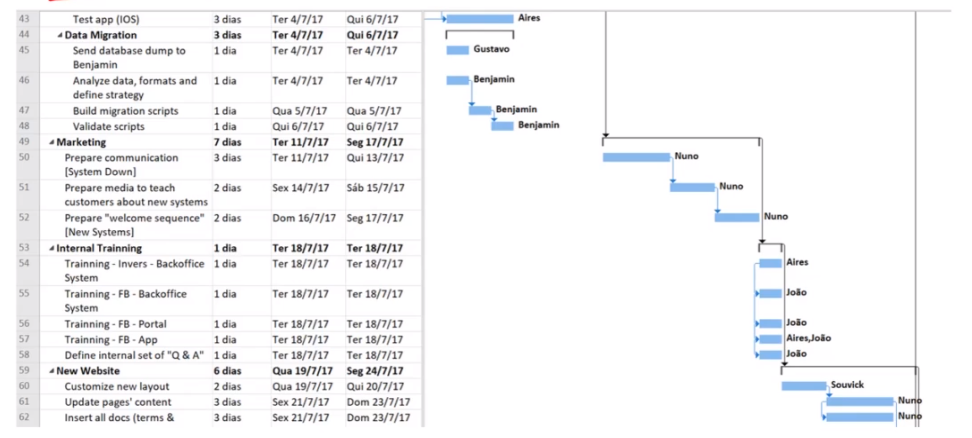
#### Gantt schedule for project
Commonly used in traditional projects.
#### 5 Stages
1. Initiation
2. Planning
* One difference of traditional from agile, is the effort on planning on traditional is mostly made during the early stages of the project.
* This means that at an early stage, you need to predict as most as possible everything that will happen after.
3. Execution
4. Closure
5. Monitoring and Control
#### Knowledge vs Ease of Change
* You as a client will have to face the situation of knowing that you don't know exactly what you want,
* Will sign a contract for a project that you know that was not very well defined,
* And accept that you will not be allowed to change it later,
Because changes at the end are very costly.
#### When Traditional is better?
* Low scope uncertainty.
* When the scope will be well defined since the beginning of the project, and very unlikely to change.
* Low client availability.
* And others...
#### Accidental Changes
Can be controlled and avoided.
#### Essential Changes
Happens and we have no control over them.
## Agile
### The "Traditional" vs Agile
#### Waterfall
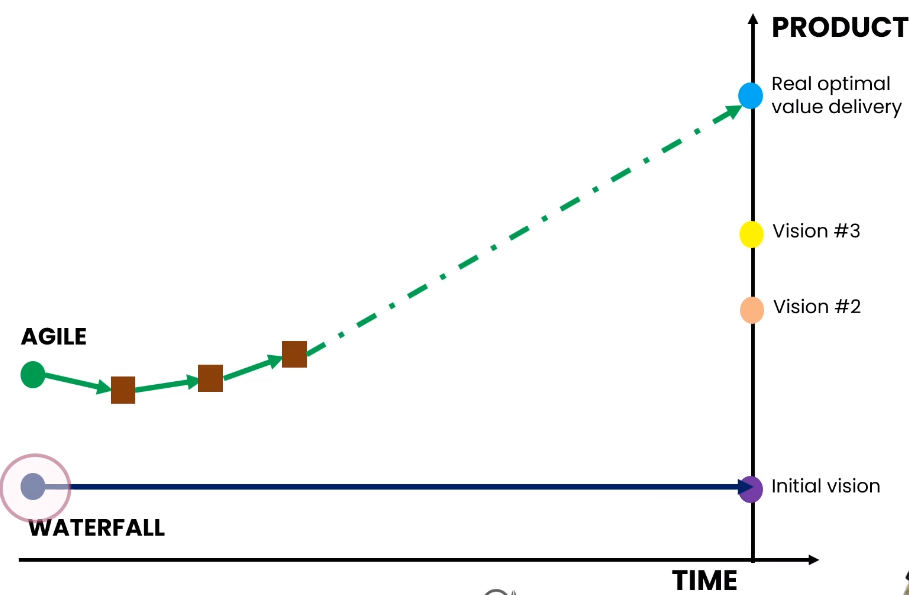
The waterfall approach also known as traditional, pro-active, predictive, plan driven and discipline.
***In waterfall, you plan on develop the perfect plan then follow it.***
The problem comes because the correct vision, hardly is the initial one, as things change in the business world.
In theory you could change the plan, to adapt to changed vision. But in practice, it would not change the vision much, because of the associated cost and bureaucracy.
As a result, two thing can happen:
* The implemented changes might not be enough to deliver the correct vision.
* We might at some point get the correct vision, but it will be so late, that it might be useless.
Is best suited for problems with low uncertainty.
> Like build bridges or buildings.
#### Agile
* In agile we assume initially that we don't know the target.
* We know that we cannot come up with the perfect plan.
* The ideia is to deliver something close to the customer needs, in short cycles, and learn with the experience.
* **IKIWISI** -> **I Know it When I see it**.
* Agility means responding to change.
It is best suited for **complex environments**.
> Like softwares.
### Agile X Rapid X Lean
#### Rapid
Is being agile the same thing as being rapid or fast?\
\&#xNAN;***NO.***
Just being rapid is not enough, because all the adaptations in vision (aka, cycles), are considered waste.\
So if you are just rapid, you just deliver waste faster.
But if you are agile AND slow, you end up just like Waterfall.
For achieving agility, you must be rapid.
{% hint style="info" %}
```
Think about a 'bullet' and a 'leopard'.
The bullet if rapid, but it cannot ajust to the enviroment, it just goes straight.
The leopard in the other hand IS agile, because it is rapid and can also adapt to the enviroment.
```
{% endhint %}
#### Lean
Agility is more related to getting the correct product, but we need to get there efficiently by reducing the waste.
Reducing waste is what is known as being lean.
We produce waste whenever we work on anything not part of the correct product vision.\
Thus the value of agile comes from being capable of making the necessary adjustments with the minimum waste as possible .
#### Conclusion
Succeeding with agile and scrum requires being rapid and lean.